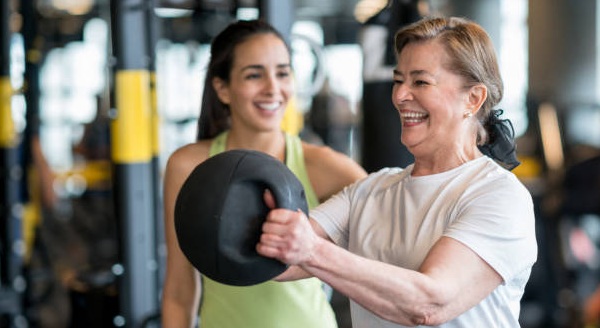
Pregnancy doesn’t mean putting exercise on hold. Staying active during pregnancy can help you maintain strength, manage aches and pains, support your mental health and prepare your body for birth and recovery.
But pregnancy also means your body is constantly changing. The goal isn’t to push through or maintain your pre-pregnancy routine at all costs — it’s to keep moving, stay strong and adapt as your body changes.
A note before you start
This article provides general information only and is based on current Australian guidelines for physical activity during pregnancy. Every pregnancy and recovery is different, so if you are unsure whether an activity is appropriate for you, or something doesn’t feel right, please seek advice from your physiotherapist, midwife, obstetrician or other healthcare professional before continuing.
How much exercise should I do?
For a healthy, uncomplicated pregnancy, Australian guidelines recommend aiming for:
- 2.5–5 hours of moderate activity each week
- Strength exercises at least twice a week
- Pelvic floor exercises
- Regular movement throughout the day, including breaking up long periods of sitting
You don’t need to hit these targets perfectly every week. Some days you might feel great; other days, a 10 minute walk might be all you manage.Something is better than nothing!
Exercise through the trimesters
First trimester (Week 1-13): Keep doing what feels good
You might not have a bump yet, but your body is already doing plenty of work. Tiredness, nausea, dizziness and changing energy levels can all affect how much you feel like exercising.
If you were exercising before pregnancy, you can generally continue your usual activities if your pregnancy is uncomplicated and they remain comfortable. If you weren’t exercising before pregnancy, start gently and build up gradually.
Good options
- Walking
- Swimming
- Stationary cycling
- Light-to-moderate strength training
- Pilates, yoga or mobility work
- Pelvic floor exercises
The goal: maintain movement and strength rather than chasing personal bests.
Second trimester (Week 14-27): Modify, don’t quit
Your bump is growing, your balance may change and exercises that once felt easy can suddenly feel awkward- that’s normal! Instead of stopping altogether, modify.
You might:
- Reduce the weight
- Shorten the workout
- Change your position
- Reduce impact
- Take longer rest breaks
- Swap an exercise for something more comfortable
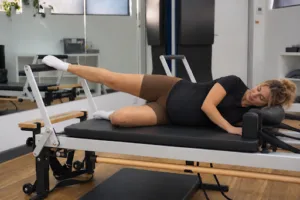
Don’t forget your glutes!
Your glutes help with walking, stairs, getting up from a chair and keeping your pelvis and legs stable.
You don’t need a complicated gym program to maintain them.
As pregnancy progresses, standing and supported exercises may become more comfortable than exercises performed on the floor.
Simple glute exercises:
| Early pregnancy | Middle pregnancy | Later pregnancy |
|
|
|
Pick 2–3 exercises that feel comfortable rather than trying to do everything.
Third trimester (Week 28-birth): Work with your body
By now, your bump may be making some movements feel very different.
You might notice:
- You’re getting tired more quickly
- Your balance feels different
- Some positions aren’t comfortable
- Walking uphill feels harder
- Your back or pelvis feel more uncomfortable
This doesn’t necessarily mean you need to stop exercising, but more so that exercise modification may be appropriate.
And remember: 10 minutes counts. If 30 minutes feels like too much, do 10. If one 30 minute walk isn’t comfortable, try three 10 minute walks. There is no perfect pregnancy workout.
What does “light-to-moderate” actually mean?
You don’t necessarily need to know exactly how many kilograms you should lift. Instead, ask yourself.
“Could I do a few more?”
If you finish a set thinking, “I could probably do another 3–4 repetitions,” you’re probably working at a reasonable level for a general pregnancy strength session.
You should be able to:
- Maintain good technique
- Breathe normally
- Control the movement
- Finish without feeling completely exhausted
For aerobic exercise, the talk test is useful too. During moderate activity, you should generally still be able to hold a conversation.
Pelvic Floor Exercises
Your pelvic floor: more than just “squeeze!”
Your pelvic floor supports your bladder, bowel and reproductive organs and plays an important role in continence and sexual function. Pregnancy and birth place extra demands on these muscles, so looking after them is important. Pelvic floor exercises during pregnancy can reduce the risk of urinary leakage, but there’s an important point that is sometimes missed:
Your pelvic floor needs to be able to tighten AND relax.
If pelvic floor exercises cause pain, discomfort or a feeling that you can’t relax the muscles, don’t simply do more exercises. An Inertia Health Group physiotherapist can help assess what’s happening and tailor your exercises.
Your Pregnancy exercise traffic lights
A simple way to monitor how exercise is feeling is to think of it like traffic lights.
| GREEN — Keep going | AMBER — Modify | RED — Stop and seek medical advice |
You feel:
Keep moving. |
Something doesn’t feel quite right.
You might notice:
Slow down, change the exercise or take a break. If symptoms persist, speak with your healthcare professional. |
Stop exercising and seek medical advice if you experience:
These symptoms shouldn’t simply be pushed through. |
Traffic-light framework adapted from the Australian Government’s Guidelines for physical activity during pregnancy, including recommendations regarding modifying activity and warning signs requiring cessation of exercise and medical advice – Australian Government pregnancy and postnatal activity recommendations
What happens after the baby arrives?
Having a baby is a huge physical event, whether you have a vaginal birth or caesarean.
For the early weeks, focus on recovery and reconnecting with muscles gradually before rebuilding.
Weeks 0–2
Gentle movement may include:
- Short walks
- Breathing exercises
- Gentle pelvic floor connection when comfortable
- Gentle mobility
- Everyday activities with your baby
Some days you’ll feel like doing more. Other days, getting through a shower might be the key achievement. Both are normal.
Weeks 2–6
Gradually build:
- Walking
- Everyday movement
- Gentle strengthening
- Pelvic floor exercises
- Comfortable mobility
Your recovery may be faster or slower than someone else’s and that’s okay.
Around 6 Weeks+
The Australian Government recommends a gradual return to activity after the six-week postnatal health check, depending on your individual circumstances.
Six weeks is a check-in point, not a magic finish line. This is where Physiotherapists at Inertia Health Group can provide individual advice and recommendations.
Australian Government pregnancy and postnatal activity recommendations
The most important thing
You don’t need to train like an athlete to have a healthy pregnancy. You don’t need the perfect workout. And you definitely don’t need to feel guilty when pregnancy means your plans change.
Your exercise might look different at 12 weeks, 24 weeks, 36 weeks and six weeks after birth and that’s okay.
Keep moving.
Keep strengthening.
Keep listening to your body.
Adapt as you go.
And ask for help when something doesn’t feel right.
Written by
Lauren Gee
Senior Physiotherapist | Master of Physiotherapy
University of South Australia
Evidence and further reading
Australian Government Department of Health, Disability and Ageing (2026)
Recommendations for pregnancy. Updated 13 March 2026.
Australian pregnancy physical activity recommendations
Australian Government Department of Health, Disability and Ageing (2026)
Physical activity during pregnancy – guidelines brochure.
Australian pregnancy exercise guidelines brochure
Prevett C, Gingerich J, Sivak A, Davenport MH. (2025).
Resistance training in pregnancy: systematic review and meta-analysis of pregnancy, delivery, fetal and pelvic floor outcomes. British Journal of Sports Medicine, 59, 1173–1182.
PubMed – Resistance training in pregnancy systematic review
Beamish NF et al. (2025).
Impact of postpartum exercise on pelvic floor disorders and diastasis recti abdominis: a systematic review and meta-analysis. British Journal of Sports Medicine, 59, 562–575.
PubMed – Postpartum exercise systematic review
Walsh SJ et al. (2026).
Lumbo-pelvic-hip complex strengthening with and without isolated pelvic floor muscle training for postpartum pelvic floor health: a systematic review and meta-analysis. Journal of Science and Medicine in Sport, 29, 19–27.
PubMed – Postpartum strengthening systematic review
Clinical and exercise professional consensus on return to running after childbirth.
British Journal of Sports Medicine.
BJSM – Return to running after childbirth