
Rolled your ankle?
Here’s our clinical take on what an ankle sprain actually is, how serious it might be, and what good rehabilitation looks like.
What is an ankle sprain?
An ankle sprain is a stretch or tear of one or more of the ligaments that hold your ankle together. Ligaments are strong bands of tissue that connect bone to bone and help keep the joint stable.
Most sprains, around 85%, affect the ligaments on the outside of the ankle. This is partly because the ankle naturally has more movement in this direction, making these ligaments more vulnerable when the foot rolls inwards (Gaddi et al., 2022).
Ankle sprains are also extremely common, with around 8 in 10 people experiencing one at some point in their lifetime (Gaddi et al., 2022).
Clinical take: A sprain is a ligament injury, not simply “a bit of swelling”.
How does an ankle sprain happen?
Most ankle sprains occur when the foot rolls inwards underneath you. This can happen when landing from a jump, stepping onto an uneven surface or changing direction quickly.
When this happens, the ligaments on the outside of the ankle are stretched, with the anterior talofibular ligament often being the first to sustain injury.
This is why ankle sprains are particularly common in sports involving jumping, landing and rapid changes of direction.
Clinical take: It is the movement of the ankle that determines which structures are injured.
How serious is my ankle sprain?
Ankle sprains are commonly described as Grade I, II or III depending on the extent of ligament damage.
Grade I involves stretching and minor tearing of the ligament. There may be mild swelling and discomfort, but the ankle generally remains stable and weight bearing is usually possible.
Grade II involves a partial ligament tear. Pain and swelling are typically greater, and the ankle may feel unstable or “loose”.
Grade III involves a complete tear of one or more ligaments. These injuries can cause significant swelling, difficulty weight bearing and considerable instability.
Higher-grade injuries generally take longer to recover. However, the grade alone does not tell us everything. Your pain, strength, balance, movement and ability to use the ankle are all important when deciding how well it is recovering.
Clinical take: The grade describes the structural injury, but your function tells us how the ankle is actually doing.
What else can happen when I sprain my ankle?

Not every “sprain” is just a simple ligament injury. A small proportion are associated with a fracture, which is why checking the bones is important following a significant injury.
Other injuries can include a high ankle sprain involving the syndesmosis, irritation of the tendons around the ankle, injury to the cartilage within the joint, or damage to the ligaments on the inside of the ankle.
One of the bigger long-term concerns is chronic ankle instability. This can involve repeated giving way, weakness or recurrent sprains, particularly when the initial injury is not fully rehabilitated.
Clinical take: If your ankle is not settling as expected, it is worth having it reassessed.
Do I need surgery?
Almost always, no.
Most ankle sprains respond well to non-surgical treatment. This usually involves supporting the ankle while progressively restoring movement, strength, balance and function.
Even many complete ligament tears can recover successfully without surgery. An operation is generally reserved for more specific situations, such as certain unstable high ankle sprains or persistent instability that has not improved with appropriate rehabilitation.
Clinical take: For most ankle sprains, rehabilitation is the main treatment — surgery is the exception.
Where do I start?

In the early stages, the goal is to settle pain and swelling without completely shutting the ankle down.
Support such as a brace can help, while weight bearing should generally progress as pain allows. Gentle ankle movement can also help restore mobility. Simple exercises such as ankle circles or controlled movements through your comfortable range are a useful starting point.
Your physiotherapist may also use hands-on treatment to help restore ankle movement, particularly when stiffness is limiting your ability to walk normally.
Clinical take: Settle it, support it, but don’t completely shut it down. Early, appropriate movement is important.
How do I progress my ankle sprain?
Once pain and swelling begin to settle, rehabilitation becomes more active.
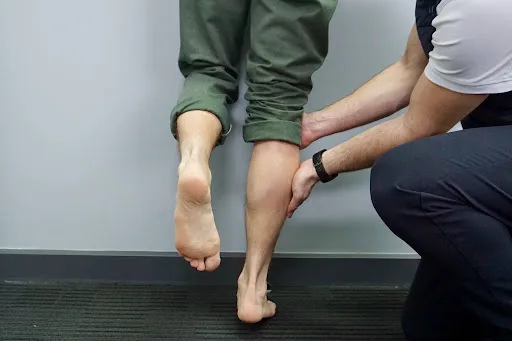
This usually starts with strengthening the muscles around the ankle, including the muscles on the outside of the lower leg. Exercises can progress from controlled ankle movements and calf raises to more demanding strengthening.
Balance and proprioception are also important. Single-leg standing can be progressed to more challenging balance exercises as your control improves. This is more than simply “standing on one leg” — the goal is to retrain how your ankle responds to changes in position and load. Balance and exercise-based rehabilitation can reduce the risk of future ankle sprains.
For athletes, the final stage involves gradually rebuilding running, hopping, landing and change-of-direction movements before returning to full training and competition.
Clinical take: Don’t stop rehabilitation when you can walk without pain. Build the ankle back to the demands you actually want to place on it.

When is my ankle better?
Recovery times vary. A mild sprain may feel close to normal within a few weeks, while higher-grade injuries and high ankle sprains can take considerably longer.
Importantly, “better” does not simply mean the swelling has disappeared. A well-recovered ankle should have regained its strength, balance, movement and confidence.
Having sprained an ankle before is one of the strongest risk factors for sustaining another sprain (Hoveidaei et al., 2025). This is why completing your rehabilitation matters, even when the ankle starts to feel normal.
The takeaway…
Most ankle sprains recover well without surgery. The early focus is on managing symptoms and restoring movement, followed by progressive strengthening, balance work and sport or activity-specific loading.
The grade of the injury can give us an idea of the expected recovery time, but how well you restore function is just as important.
If your ankle is significantly swollen, feels unstable, you cannot bear weight comfortably, or it is not improving as expected, an assessment can help determine what has been injured and guide your rehabilitation.
If you’d like guidance tailored to your ankle and your goals, our team is here to help.
Written by
George D’Agostino
Physiotherapist | Bachelor of Physiotherapy (Hons.)
University of South Australia
References
Dhillon, M.S., Patel, S. & Baburaj, V. (2023). Ankle sprain and chronic lateral ankle instability: Optimizing conservative treatment. Foot and Ankle Clinics, 28(2), 297–307.
Gaddi, D., Mosca, A., Piatti, M. et al. (2022). Acute ankle sprain management: An umbrella review of systematic reviews. Frontiers in Medicine, 9, 868474.
Hoveidaei, A.H., Moradi, A.R., Nakhostin-Ansari, A. et al. (2025). Risk factors of ankle sprain in soccer players: A systematic review and meta-analysis. Sports, 13(4), 105.
Ruiz-Sánchez, F.J., Ruiz-Muñoz, M., Martín-Martín, J. et al. (2022). Management and treatment of ankle sprain according to clinical practice guidelines: A PRISMA systematic review. Medicine, 101(42), e31087.
Ankle sprains: A review of mechanism, pathoanatomy and management. (2023). Surgery (Oxford).