

Have you ever stood up too quickly, rolled over in bed, or turned your head quickly to look behind you and suddenly felt like the world was spinning? That spinning sensation is a common experience of vertigo. Here’s a closer look at what vertigo is, what can cause it, and how it can be treated.
What is vertigo:
Vertigo is typically described as a sensation of spinning or movement, either of yourself or the environment around you. It is different from dizziness, which can feel more like lightheadedness or floating, and imbalance, which is generally described as feeling unsteady or having difficulty maintaining your balance.
Vertigo is often related to the vestibular system, which helps your brain understand the position and movement of your head. Symptoms may be triggered by specific head movements and can range from brief episodes lasting seconds to more prolonged periods. Vertigo can also leave you feeling nauseous or unsteady.
Vestibular System:
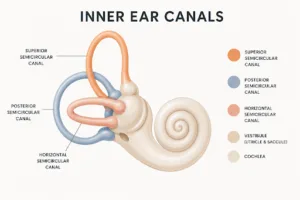
Your vestibular system is located within your inner ear and is made up of fluid-filled canals, sensory receptors and tiny calcium carbonate crystals called otoconia (or otoliths). Tiny hair cells within the inner ear detect movement of the fluid as you move your head. These signals are then sent to your brain, helping it understand where your head is positioned and how it is moving through space.
When something disrupts this system or the pathways carrying these signals to the brain, the information can become mismatched, resulting in symptoms such as vertigo, dizziness or imbalance.
Common Causes:
Benign Paroxysmal Positional Vertigo (BPPV)
BPPV is one of the most common causes of vertigo. It occurs when tiny crystals within the inner ear become displaced and move into one of the semicircular canals. This can cause the brain to receive false signals of movement when you move your head, resulting in a brief spinning sensation. Episodes typically last 10–20 seconds and are often triggered by movements such as rolling over in bed, looking up or bending down.
The good news? BPPV can usually be treated effectively with specific head and body movements that reposition the displaced crystals.
Vestibular Neuritis
Vestibular neuritis occurs when the vestibular nerve, which carries balance information from the inner ear to the brain, becomes inflamed. It can occur during or following a viral infection and may cause sudden, prolonged vertigo, dizziness and imbalance. Symptoms can last for several days, with some people experiencing ongoing symptoms for weeks or months as the vestibular system recovers.
Ménière’s Disease
Ménière’s disease is associated with an abnormal build-up of fluid within the inner ear. It can cause episodes of vertigo along with symptoms such as ringing in the ears (tinnitus), hearing loss and a feeling of fullness or pressure in the ear.
Cervicogenic Dizziness
Cervicogenic dizziness is not technically vertigo, but it can be a common contributor to dizziness and unsteadiness. It is thought to be related to altered information from the muscles and joints of the neck, which provide important information to the brain about head and body position. This can occur following neck injury, such as whiplash, or alongside changes in neck movement, posture or muscle function.
Managing and Treating Vertigo
Treatment depends on the underlying cause of your symptoms.

BPPV: Specific head and body movements can be used to reposition the displaced crystals. One of the most commonly used techniques is the Epley manoeuvre, which helps guide the crystals out of the semicircular canal. We usually use a Dix Hall Pike test to assist in combination with your subjective examination if this is the cause of your issue. If it is negative and does not replicate your symptoms we begin to consider some other conditions as well as the possibility of needing to explore your horizontal canals.
Vestibular rehabilitation: Vestibular rehabilitation involves specific exercises prescribed by a physiotherapist to help the brain adapt to changes in the vestibular system and improve symptoms such as dizziness, imbalance and motion sensitivity.
Medication: Your doctor may prescribe medication to help manage symptoms such as nausea or severe vertigo, particularly in the short term.
Lifestyle adjustments: Simple strategies such as getting up more slowly, avoiding sudden head movements, staying hydrated and identifying individual triggers may also help manage symptoms.
The Takeaway
Vertigo can be a very unpleasant and sometimes frightening experience, but many causes of vertigo can be effectively managed and treated.
If you experience a room-spinning sensation, recurrent dizziness or ongoing unsteadiness, it’s worth seeking professional assessment to determine the underlying cause.
Our physiotherapy team can assess your symptoms and help develop an appropriate treatment plan to get you moving and feeling more confident again.
Sarah Baker
Physiotherapist
Bachelor of Physiotherapy (Hons.)
University of South Australia
References
De Vestel, C., Vereeck, L., Reid, S.A., Van Rompaey, V., Lemmens, J. and De Hertogh, W. (2022). Systematic review and meta-analysis of the therapeutic management of patients with cervicogenic dizziness. Journal of Manual & Manipulative Therapy, pp.1–11. doi:10.1080/10669817.2022.2033044.
Halmagyi, G. (2005). Diagnosis and management of vertigo. Clinical Medicine, [online] 5(2), pp.159–165. doi:10.7861/clinmedicine.5-2-159.
Madrigal, J., Manzari, L., Figueroa, J.J. and Castillo-Bustamante, M. (2024). Understanding Benign Paroxysmal Positional Vertigo (BPPV) and Its Impact on Quality of Life: A Systematic Review. Curēus, 16(6). doi:10.7759/cureus.63039.
National Institute on Deafness and Other Communication Disorders (2024). Ménière’s Disease. [online] NIDCD. Available at: https://www.nidcd.nih.gov/health/menieres-disease [Accessed 26 Aug. 2026].
Smith, T., Rider, J., Cen, S. and Borger, J. (2019). Vestibular Neuronitis. [online] Nih.gov. Available at: https://www.ncbi.nlm.nih.gov/books/NBK549866/ [Accessed 26 Aug. 2026].