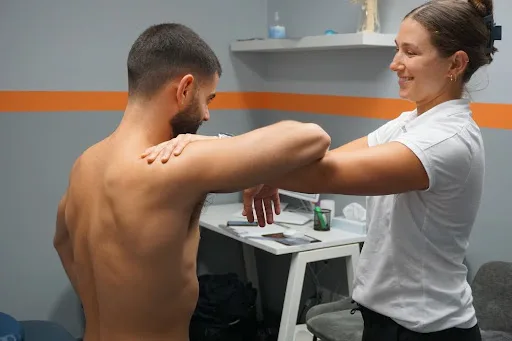
Frozen shoulder (also called adhesive capsulitis) is one of the most misunderstood shoulder problems. Symptoms can occur for months, stop you sleeping on one side, and make simple things, reaching for a seatbelt, doing up a bra difficult or impossible.
The good news: for most people it is treatable without surgery, and Physiotherapy can get you back to moving more, quicker and a lot more comfortable.
What is a frozen shoulder?
It’s a condition where the capsule around the shoulder joint becomes inflamed, thickened and tight. That tightening causes the two classic features: pain, and a gradual loss of movement, especially turning the arm out or reaching behind your back or lifting your arm up.
It isn’t a muscle “knot”, and it isn’t caused by sitting badly. The tissue around the joint genuinely stiffens, which is why the shoulder locks up rather than just feeling sore.
How long does it last?
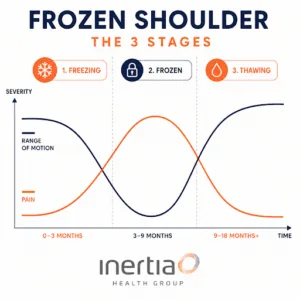
Frozen shoulder tends to move through three overlapping stages: a painful (freezing) stage, a stiff (frozen) stage, and a thawing stage where movement returns.
It can be slow, sometimes lasting several months to a couple of years. Most people improve within 6 to 18 months, and rarely need surgery. Knowing which stage you’re in matters,
because it changes what helps most right now.
How Physiotherapy Helps with a Frozen Shoulder:
Physiotherapy is the first line treatment in most cases. The aim is simple: keep you as comfortable, strong and mobile as possible while the shoulder works through its stages.
A good plan is matched to your stage. Early on, when things are painful and irritable, the focus is on settling pain, protecting sleep, and gentle movement that doesn’t flare things up. As the shoulder calms down, we shift towards stretching and strengthening to restore range and rebuild the muscles around the joint.
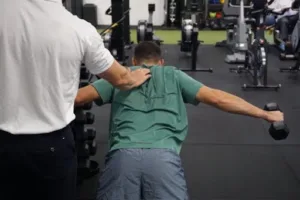
Hands-on techniques have a role too. Physio-guided joint mobilisations (gentle movement of the joint combined with your own active movement) has been shown to improve pain and range when added to exercise.
One honest point: no exercise program makes a frozen shoulder thaw overnight, and forcing it usually backfires. The value of Physiotherapy isn’t a quick fix, it’s helping you move better, hurt less, and avoid losing function on the way through.
Clinical take: Physiotherapy won’t “snap” the shoulder back, but it keeps you moving and recovering well. It’s the foundation everything else builds on.
Where do injections fit in?
Sometimes pain is too high for movement and rehab to get going. That’s where injections can help as a tool to support physio.
Cortisone injections can settle pain, and they’re most useful in the early, painful stage. They open a window of lower pain so you can move and rehabilitate more comfortably. They do not act to reduce the stiffness in the tissue.
Hydrodilatation is a procedure where fluid (usually saline, local anaesthetic and often cortisone) is injected into the joint to gently stretch the tight capsule. It can ease pain and create a little more room to move. Evidence shows that Physiotherapy mobilisations and treatment within a 12 hour window of this can further increase the benefits.
Both can be genuinely useful, but the benefit is mainly short-term, and they work best followed by Physiotherapy rather than used on their own.
The takeaway:
Frozen shoulder is common, often slow, and usually better than the worst stories suggest. Physiotherapy and exercise are the core of treatment, and injections like cortisone or hydrodilatation can help get pain under control so you can move and recover.
If your shoulder is stiff, painful or holding you back, our physio team can help you work out where you’re at and what will help most.
Physiotherapist
Bachelor of Physiotherapy (Hons.)
University of South Australia
References
Albishi, W., Murad, K., Alaseem, A., Awwad, W., & Alsanawi, H. (2022). The effectiveness of nonoperative treatment modalities in the management of frozen shoulder: A systematic review of randomized controlled trials. Muscles, Ligaments and Tendons Journal, 12(2). https://doi.org/10.32098/mltj.02.2022.03
Hanchard, N., Goodchild, L., Thompson, J., O’Brien, T., Richardson, C., Davison, D., Watson, H., Wragg, M., Mtopo, S., & Scott, M. (2011). Evidence-based clinical guidelines for the diagnosis, assessment and Physiotherapy management of contracted (frozen) shoulder. Chartered Society of Physiotherapy.
Millar, N. L., Meakins, A., Struyf, F., Willmore, E., Campbell, A. L., Kirwan, P. D., Akbar, M., Moore, L., Ronquillo, J. C., Murrell, G. A. C., & Rodeo, S. A. (2022). Frozen shoulder. Nature Reviews Disease Primers, 8(1), Article 59. https://doi.org/10.1038/s41572-022-00386-2
Page, M. J., Green, S., Kramer, S., Johnston, R. V., McBain, B., Chau, M., & Buchbinder, R. (2014). Manual therapy and exercise for adhesive capsulitis (frozen shoulder). Cochrane Database of Systematic Reviews, 2014(8), Article CD011275. https://doi.org/10.1002/14651858.CD011275
Satpute, K., Reid, S., Mitchell, T., Mackay, G., & Hall, T. (2022). Efficacy of mobilization with movement (MWM) for shoulder conditions: A systematic review and meta-analysis. Journal of Manual & Manipulative Therapy, 30(1), 13–32. https://doi.org/10.1080/10669817.2021.1955181