What are the parts of the hamstring muscle and tendon?
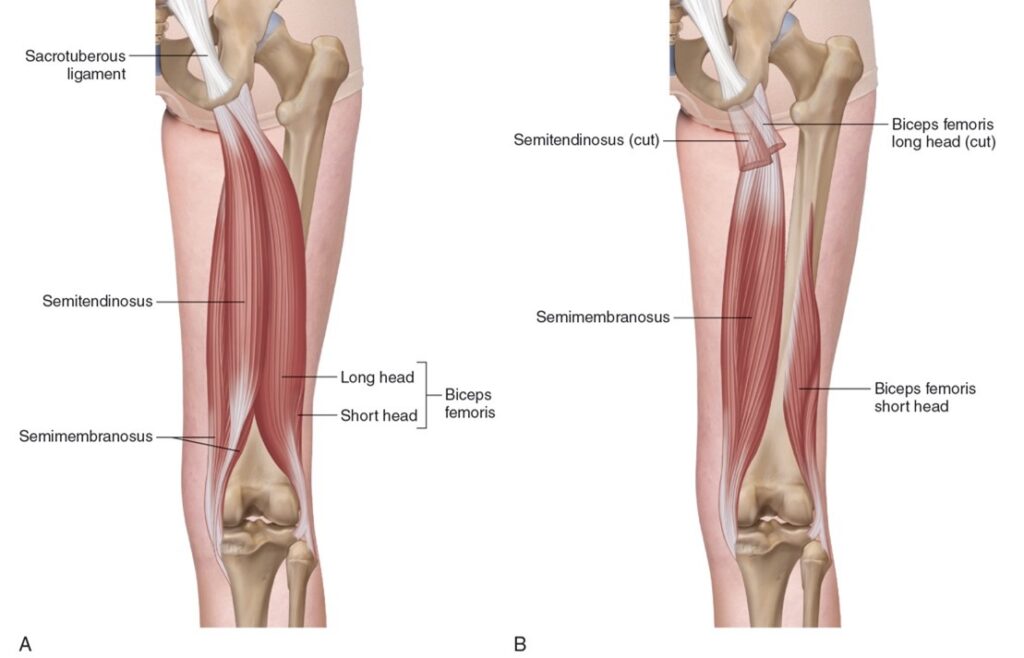
The hamstring muscle group is made of three muscles. The lateral hamstring consists of the Biceps Femoris (short head and long head) and the medial hamstrings semitendinosus (superficial) and semimembranosus (baritone). The muscles all originate from the ischia tuberosity of the pelvis or sitting bone. This group of muscles goes all the way up to the knee. The medial hamstring muscles attach to the inside of the tibia, and the biceps femoris attaches to the fibula.
What are the actions of the hamstring muscles?
The hamstrings cross both the hip and the knee joint, meaning they can impact both hip and knee motion. This means they assist in flexing the knee and extending the hip as their primary actions. However, they greatly influence the deceleration of the tibia in sprinting efforts.
Who usually suffers from a hamstring tendon injury? Hamstring Injury and Athletes;
Due to the high-force actions of the hamstrings, we see many hamstring tendons and muscle injuries in high-paced sprinting sports such as Australian Rules football, soccer, and rugby.
We also see more proximal hamstring (upper part of the hamstring) tendinopathy in runners and distance athletes. These forms of injury are often referred to as load-based injuries and are usually caused by a load-and-recovery mismatch. Other factors, such as strength training and endurance, play a role in these injuries.
How do these proximal hamstring tendon injuries present?
We usually see pain localising around the ischial tuberosity (sitting) bone. Pain is usually worsened by sitting, running, lunging, and bending forward, increasing the compression on the tendon by increasing the tension through the hamstrings. Pain is generally described as a constant, dull ache, depending on the stage of the injury and irritability. In more severe cases, it may warm up with activity but become painful after training or be limited during exercise.
There are other causes of pain around the area of the hamstring tendon.
There are many other structures and reasons why pain could be present around the sitting bone, or you could get hurt in your hamstring.
Here is a list of differential diagnoses or other reasons for pain in the area. Your Physiotherapist will be able to reason and clinically test to rule in or out these causes of injury.
- Sciatic Nerve irritation around the piriformis muscle or the ischial tuberosity
- Ischiofemoral impingement
- The unfused growth plate in post-adolescent athletes
- Apophysitis or growth plate avulsions or separations
- Deep gluteal muscle tear
- Stress fractures of the pubic or ischial ramus
- Partial or complete rupture or tear of the proximal hamstring tendons
How do we successfully treat these types of hamstring tendon injuries?
We need to use your pain levels as a guide when increasing exercise or load exposure to your tendon injury. We know that isometric exercises (holding a contraction against a resistance) can reduce pain and reverse the muscle’s cortical inhibition (inhibition of the power means the ability to switch on’ or contract and exert or absorb force). Isometric exercises are undoubtedly worthwhile to maintain throughout the rehabilitation process.
Once we have your pain levels under control and the tissue or tendon can more comfortably absorb and tolerate the load, we can begin the fun stuff. This ‘fun stuff’ depends on the specific demands of your sport or exercise. Usually, we will stage loading and particular loading forms, such as moving through eccentric to eccentric, concentric loads, then play with fast or slow speeds in specific ranges or through ranges. It depends on the individual, as no person or tendon is the same and often requires gentle tweaking of programming. Once we have seen improvement in load tolerances through strength increases and improvements in mobility with associated reductions in pain reporting, we can begin more dynamic, plyometric, and power loading, such as running, jumping, and sprinting, and match the demands of the tendon and its associated sporting requirements.
However, we have to be sure that we do not neglect the whole kinetic chain (force transfer through the upper to lower body and vice versa) and how crucial it is in optimising rehabilitation and performance post-injury, ensuring a triumphant return to play and performance.
What exercises are used to help with hamstring tendon injuries?
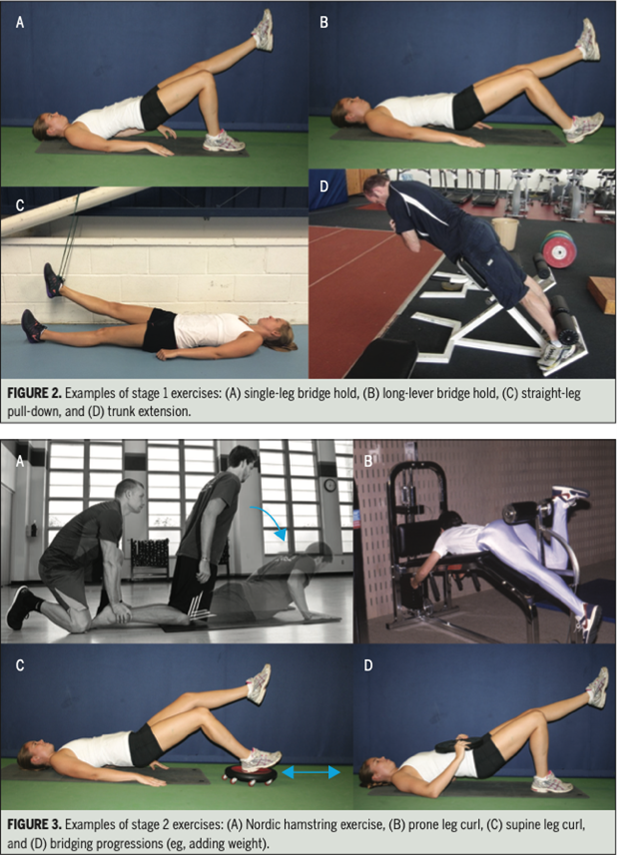
As mentioned, we use various exercises in different ranges at various stages of rehabilitating hamstring tendon injuries.
Below are some examples of exercises we regularly use in the clinic for the treatment of this condition. The pictures have been taken from a clinical commentary by Goom, TH, Malliaras, P, et al. (2016, ‘Proximal Hamstring Tendinopathy: Clinical Aspects of Assessment and Management’ Journal of Orthopaedic & Sports Physical Therapy, Vol. 46, No. 6, pp. 483–493.


References
Goom, TH, Malliaras, P et al., 2016, ‘Proximal Hamstring Tendinopathy: Clinical Aspects of Assessment and Management’ Journal of Orthopaedic & Sports Physical Therapy, vol. 46, no. 6, pp. 483–493.
Orchard J, Best TM, and Verrall GM Return to play following muscle strains. Clin J Sports Med. Nov 2005;15(6):436-441.
Orchard J, Marsden J, Lord S, and Garlick D. Preseason hamstring muscle weakness associated with hamstring muscle injury in Australian footballers Am J Sports Med. Jan-Feb 1997;25(1):81-85.